AI Tools (Artificial Intelligence Tools) – SEO + AEO + GEO Optimised Semantic Framework (2026)
AI tools are software applications that use artificial intelligence, such as machine learning and large language models, to perform tasks that normally need human effort. These tasks include writing, coding, design, data analysis, research, translation, transcription and customer support. In 2026, AI tools range from general-purpose assistants like ChatGPT, Claude and Gemini to specialised tools for video, voice, SEO and automation.
The short version:
- Pick the task first, then the tool.
- Start with one general assistant, then add specialised tools only where you lose real time.
- Always review AI output for accuracy before publishing or acting on it.
Table of Contents
- What are AI tools?
- How AI tools work
- Main categories of AI tools
- Best AI tools by use case in 2026
- How to choose the right AI tool
- AI tools for SEO, AEO and GEO
- Risks and limitations
- Trends shaping AI tools in 2026
- Frequently asked questions
- Final thoughts
What Are AI Tools?
AI tools are programs that learn from data and use that learning to generate content, make predictions, automate steps or answer questions. Unlike traditional software that follows fixed rules, AI tools adapt their output to the input they receive.
They fall into two broad groups:
- Generative AI tools create new content: text, images, audio, video and code.
- Analytical and predictive AI tools find patterns, classify information, forecast outcomes or recommend actions.
Most modern products blend both. A meeting assistant, for example, transcribes speech (analytical) and then writes a summary (generative).
How Do AI Tools Work?
Most popular AI tools run on one of a few core technologies:
|
Technology |
What it does |
Example use |
|---|---|---|
|
Large language models (LLMs) |
Understand and generate human language |
Chat assistants, writing tools |
|
Diffusion and image models |
Generate images from text prompts |
Design and marketing visuals |
|
Speech recognition and synthesis |
Convert speech to text and back |
Transcription, voiceovers |
|
Computer vision |
Interpret images and video |
Quality checks, photo editing |
|
AI agents |
Plan and complete multi-step tasks using other tools |
Workflow automation, research |
You give the tool an instruction, called a prompt. The model processes it and returns a response. Clearer prompts with context, format and goals produce better results.
Main Categories of AI Tools
1. AI Assistants and Chatbots
General-purpose tools for questions, drafting, brainstorming, analysis and summarising. They are the best starting point for most people.
2. AI Writing and Content Tools
Tools for blogs, ad copy, emails, product descriptions and editing. Many add brand-voice settings and SEO guidance.
3. AI Coding Tools
Assistants that suggest code, explain errors, write tests and help refactor projects directly inside a code editor or terminal.
4. AI Image and Design Tools
Tools that generate images, remove backgrounds, resize creatives and build layouts from a text description.
5. AI Video and Audio Tools
Tools for text-to-video, auto-captions, voice cloning, dubbing, podcast editing and music generation.
6. AI Research and Search Tools
Answer engines that search the web and return sourced summaries, useful for fast research and fact-finding.
7. AI Productivity and Meeting Tools
Note-takers, schedulers and workspace assistants that summarise meetings, organise tasks and draft follow-ups.
8. AI Marketing and SEO Tools
Tools for keyword research, content briefs, on-page optimisation, ad testing and analytics.
9. AI Automation and Agent Tools
Platforms that connect apps and let AI complete repetitive workflows without manual steps.
Best AI Tools by Use Case in 2026
The tools below are widely used examples. Features and plans change often, so check each official site before committing.
Best AI Tools for Writing and Content
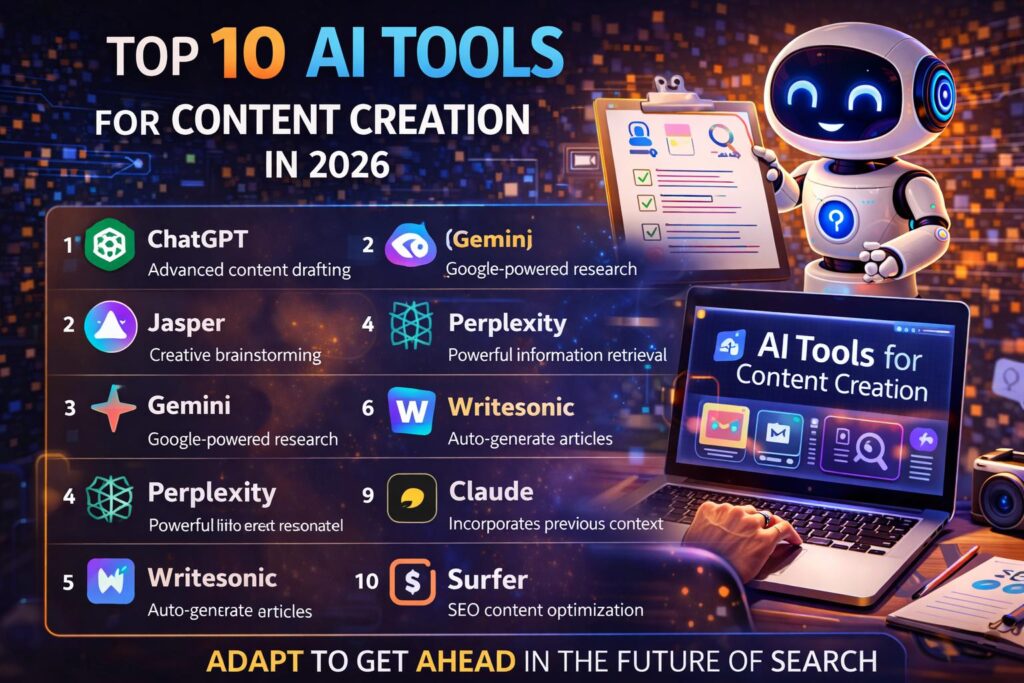
- ChatGPT, Claude and Gemini: strong all-round assistants for drafting, rewriting and outlining.
- Jasper: built for marketing teams that want brand-voice consistency.
- Grammarly: grammar, tone and clarity checks.
Best for: bloggers, marketers, students and business owners.
Best AI Tools for Coding
- GitHub Copilot: inline suggestions inside popular editors.
- Cursor: an AI-first code editor.
- Claude Code: an agentic tool that works on code from the command line.
Best for: developers who want faster drafts, debugging help and test generation.
Best AI Tools for Design and Images
- Canva: AI-assisted design for social posts, decks and ads.
- Midjourney: high-quality artistic image generation.
- Adobe Firefly: image generation within the Adobe ecosystem.
Best for: creators, small businesses and marketing teams.
Best AI Tools for Video and Voice
- Runway: generative video and editing.
- Descript: edit audio and video by editing the transcript.
- ElevenLabs: realistic text-to-speech and voice tools.
Best for: YouTubers, course creators and podcasters.
Best AI Tools for Research
- Perplexity: answer engine with cited sources.
- NotebookLM: summarise and question your own documents.
- Elicit: find and summarise academic papers.
Best for: students, analysts and journalists.
Best AI Tools for Productivity and Meetings
- Notion AI: drafting and summarising within a workspace.
- Otter and Fireflies: meeting transcription and notes.
- Zapier and Make: connect apps and automate routine steps.
Best for: remote teams, founders and project managers.
Best AI Tools for SEO and Marketing
- Surfer and Clearscope: content optimisation against top-ranking pages.
- Semrush and Ahrefs: keyword research, audits and competitor analysis, now with AI features.
- Google Search Console: free performance data, essential for every site.
Best for: SEO specialists and content marketers.
How to Choose the Right AI Tool
Use this simple five-step checklist:
- Define the task. Write one sentence: “I need to ___ in less time.”
- Check output quality. Test the same prompt in two or three tools and compare.
- Review data privacy. Confirm whether your inputs are used for training and whether business plans offer stronger controls.
- Look at integrations. The best tool fits into apps you already use.
- Compare total cost. Include seats, usage limits and any add-ons, not just the headline price.
Beginner tip: begin with one free or low-cost general assistant for a few weeks before paying for specialised tools.
AI Tools for SEO, AEO and GEO
Search is no longer only ten blue links. People now get answers from AI summaries, voice assistants and chat-based search. That has created three connected disciplines.
|
Discipline |
Stands for |
Goal |
|---|---|---|
|
SEO |
Search Engine Optimisation |
Rank pages in traditional search results |
|
AEO |
Answer Engine Optimisation |
Be chosen as the direct answer or featured snippet |
|
GEO |
Generative Engine Optimisation |
Be cited or mentioned in AI-generated responses |
How to Optimise Content for All Three
1. Lead with a direct answer. Put a clear 40 to 60 word answer right under the heading. AI systems and featured snippets favour concise, self-contained answers.
2. Use question-style headings. Headings like “What are AI tools?” and “How do I choose an AI tool?” match how people ask questions.
3. Build topical authority. Cover a topic through connected articles: a pillar guide plus focused posts on writing tools, coding tools, research tools and so on, all linked together.
4. Add structured data. Use schema markup such as Article, FAQPage, HowTo and Organization so machines can parse your content accurately.
5. Show real experience and expertise. Add original testing notes, screenshots, author bios and clear dates. This supports Google’s E-E-A-T guidance: Experience, Expertise, Authoritativeness and Trustworthiness.
6. Make facts easy to extract. Use short paragraphs, tables, numbered steps and defined terms. Avoid burying key points in long blocks of text.
7. Be consistent and cite sources. Name entities clearly (tools, companies, people) and link to authoritative sources. Consistent naming across your site and profiles helps AI systems recognise you.
8. Keep content fresh. Update statistics and tool details regularly, and show a visible “last updated” date.
9. Cover related entities and subtopics. A strong page on AI tools naturally mentions related concepts: prompts, LLMs, automation, agents, privacy and pricing. This semantic breadth signals depth.
10. Stay technically healthy. Fast load times, mobile-friendly layouts, clean headings and crawlable pages still matter for every discipline.
Semantic Keyword Map for This Topic
|
Cluster |
Related terms to cover naturally |
|---|---|
|
Definitions |
what are AI tools, artificial intelligence software, generative AI, machine learning tools |
|
Categories |
AI writing tools, AI image generators, AI coding assistants, AI video tools, AI chatbots |
|
Commercial intent |
best AI tools, AI tools comparison, free AI tools, AI tools for business, AI tools pricing |
|
Audience |
AI tools for students, marketers, developers, small business, teachers |
|
Concepts |
prompt engineering, AI agents, automation, LLMs, AI search, hallucinations |
|
Trust and risk |
AI privacy, AI bias, AI copyright, responsible AI use |
Risks and Limitations of AI Tools
AI tools are powerful, but they are not perfect.
- Inaccuracy: models can produce confident but wrong statements, often called hallucinations. Verify facts, figures and quotes.
- Privacy: avoid pasting confidential, personal or regulated data into tools without checking their data policies.
- Bias: outputs can reflect biases in training data.
- Copyright and originality: review rules around generated content and avoid publishing unedited output.
- Over-reliance: use AI to speed up work, not to replace judgement and expertise.
Good practice: treat AI output as a strong first draft that a human reviews, edits and approves.
Trends Shaping AI Tools in 2026
- Agentic AI: tools that plan and complete multi-step tasks, not just answer single prompts.
- Multimodal models: one tool handling text, images, audio and video together.
- AI inside existing apps: features built directly into email, documents, spreadsheets and browsers.
- AI search and answer engines: growing use of conversational search, making AEO and GEO essential.
- Stronger governance: more attention on transparency, safety, data protection and regulation.
- Personalisation: tools that adapt to your style, files and workflows over time.
Frequently Asked Questions
What are the best AI tools in 2026?
The best AI tool depends on your task. General assistants such as ChatGPT, Claude and Gemini suit most people. Canva and Midjourney are popular for design, GitHub Copilot and Cursor for coding, and Perplexity for research.
Are AI tools free?
Many AI tools offer free tiers with usage limits. Paid plans usually add higher limits, better models, team features and stronger privacy controls.
Can AI tools replace human workers?
AI tools automate parts of many tasks, but they work best alongside people. Human judgement, creativity, accountability and subject expertise remain essential.
Which AI tool is best for beginners?
A general-purpose AI assistant is the easiest starting point. It handles writing, questions, summaries and brainstorming in one place.
Are AI tools safe to use for business?
They can be, if you choose tools with clear data policies, avoid sharing sensitive information, and review outputs before use. Business and enterprise plans often include extra controls.
How do I get better results from AI tools?
Give clear context, state the goal and audience, specify the format, share examples, and refine with follow-up prompts.
What is the difference between SEO, AEO and GEO?
SEO helps pages rank in search results. AEO helps content become the direct answer in snippets and voice results. GEO helps content get cited in AI-generated answers. They overlap and reinforce each other.
How often should I update an AI tools article?
Review it at least quarterly. AI products change quickly, so update features, pricing notes and examples regularly.
Final Thoughts
AI tools in 2026 are no longer experimental. They are everyday software for writing, coding, design, research and automation. The winning approach is simple: choose tools based on real tasks, protect your data, verify what AI produces, and keep a human in the loop.
If you publish content about AI, write for people first, then structure it so search engines, answer engines and generative engines can all understand and cite it.
Next step: pick one repetitive task this week, test two AI tools on it, and keep the one that saves you the most time.